Net pole
The Shrinking ManThe Net pole changes from equipment swept into the confusion of a family move into a route out of Scott Carey’s cellar. Left leaning against the wall with its lower end braced by the rim to which the net is fastened, it gives Scott a broad, gradual ascent where the surrounding floor and cliff have offered few ways upward. Its significance lies in this unplanned change of use: a household object placed without regard for Scott becomes the means by which he can continue his escape.
Appearance and Placement
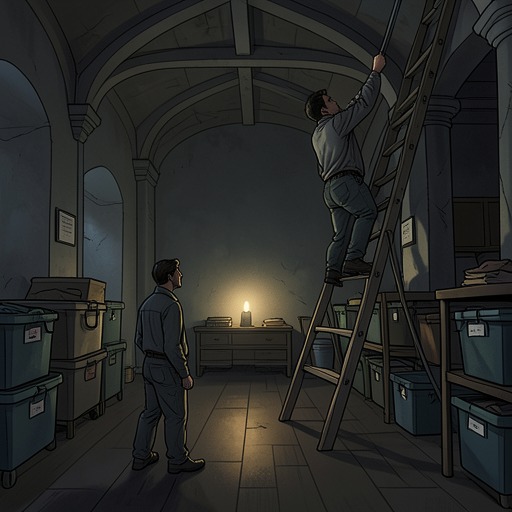
During the move, cartons fly across the cellar, followed by two canvas chairs. Marty then sends the Net pole across the floor. It falls against the cliff wall, and its lower end comes to rest against the moonlike metal rim holding the net. The narration presents the pole as a tree-scale object from Scott’s perspective, a long structure set across the landscape of the cellar. Its placement links two features that Scott can use: the net’s metal rim below and the upper edge of the cliff above.
Scott watches Marty handle a suitcase and initially does not understand why his brother is taking the suitcases downstairs. The realization that the family is moving gives the pole’s arrival its immediate circumstance. It has not been placed as a ladder or escape aid; it is among the belongings being shifted through the cellar. The move therefore alters Scott’s environment without intending to help him. The object’s practical importance emerges only later, when he recognizes what its position makes possible.
From Obstacle to Route
Before the pole offers a way up, Scott’s attempts to reach a cellar window have been constrained by both the architecture and his shrinking body. One window is too high above the sand with only a vertical wall beneath it; another is inaccessible above a log pile. The window over the fuel tank once seemed to offer a possibility, but at seven inches he could not climb the boxes and suitcases. When he eventually reached it, he had no stone with which to break the pane and had to descend. By then, his continuing shrinkage had made the earlier means of access unusable.
The Net pole answers a different problem. Scott has been looking for food, climbing threads, and killing spiders, but these efforts have not opened a way out. After noticing the pole again, he runs toward it, briefly stops to drink from the hose, and then climbs the net’s metal rim past its thick cords. From the rim he pulls himself onto the pole. The route begins not with a climb up the sheer wall, but with a transfer from the net structure onto a surface that bridges the gap toward the cliff.
The Climb and Its Consequences
The pole’s width and angle make it passable. Because it leans at a low gradient, Scott does not need to scramble upward with his hands down for support; he can move nearly upright along its broad, curving surface. What seemed to him a long, difficult ascent becomes a gradual road across the cellar. He climbs past the first lawn chair, then the second, and pauses to look down at the floor before continuing. An hour after beginning, he reaches the top of the cliff and collapses on the sand, exhausted.
The climb is a decisive but incomplete stage of escape. Once on the upper ground, Scott gets up and crosses the shadowed floor, passing the dead spider without stopping. He takes a piece of bread and continues to the spider’s web, where another climb remains ahead. The pole does not carry him out of the cellar by itself; it gets him to the cliff top and makes the next stage possible. Its consequence is therefore specific: it converts a sealed-looking vertical barrier into a traversable slope, giving Scott access to the ground beyond it.
Narrative Significance
Scott considers whether the pole’s arrival was merely chance. It had been thrown into place by his own brother, and its position now provides the route he needs. He connects this coincidence with the spider’s death the previous day, which has also contributed to his escape, and wonders whether the two events together suggest a purpose to his survival. The pole thus becomes part of a pattern Scott tries to interpret, even as the evidence offers no assurance that his survival has a larger design.
The object’s force in the episode comes from the contrast between intention and consequence. Marty handles it as one more item in the move; Scott sees it first as a towering shape against the wall and later as a usable road. Its placement is accidental, but the material facts of its width, slope, and contact with the net rim determine what Scott can do. At his reduced scale, the pole is neither merely background nor a deliberately provided tool: it is a feature of the environment whose arrangement changes the limits of his movement. The escape depends on Scott recognizing and climbing it, but also on a configuration created independently of him.